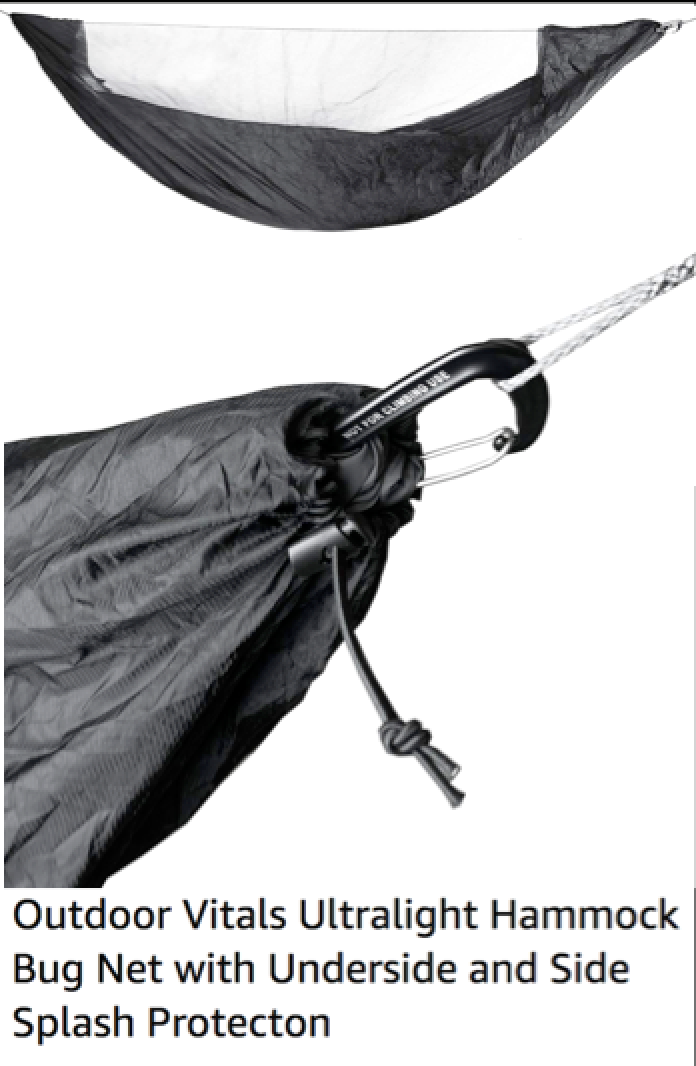
How Do I Keep the Bugs Out?
|
|
![]() DebW's Bug Bivy
|
| Fixed Bugnets. |
- Bottom-Entry
- Hennessy Hammocks. Hennessy Hammocks have the bugnet sewn directly to the hammock fabric all the way around. They have a "bottom-entry" slit in the hammock fabric, which is very weight-efficient and easy to use. Not having zippers or velcro all the way around the bugnet helps Hennessy offer the lightest fully functional hammock commercially available. However, since you have to enter from the foot end, you have to know which end is the foot when you set it up; it's hard to tell which end is the foot when the hammock is inside snakeskins. Some people put different colored drip strings on each end, or a strip of duct tape on the foot end, so they can see which end is which even while the hammock is in the snakeskins.
- Hennessy Modifications. Another downside: since you can't remove the bugnet, you have to carry that weight even in winter when it's not needed, and you can't reach your gear outside the hammock, or cook from inside the hammock, like you can some other models. But it's possible to modify the hammock and put zippers or velcro on the bugnet so you can remove it when you want to.
- Zipper-Entry
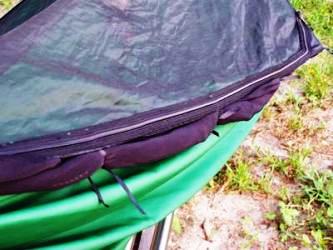
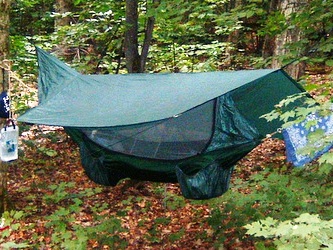
- Clark Jungle Hammocks. Clarks have zippers on both sides of the bugnet so you can roll it all the way to the top and secure it. It's not totally removable, so you'll still have to carry the weight when it's not needed in the winter, but you can get stuff from outside or increase ventilation as desired.

Clark's Zippered Bugnet
Photo by Rough
Closeup of Clark
Photo by SpiritWind - Other Versions. A few other types of hammocks use zippers for bugnets, like the Mosquito Free Hammock Bliss, the GI Jungle Hammock, and the 16 oz Byer Moskito Traveller.

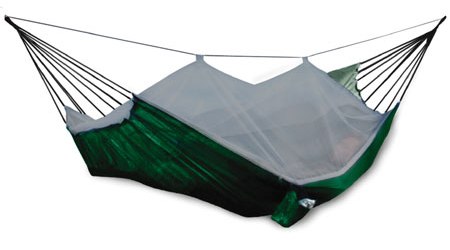
Byer Moskito Traveller
Photo from Campmor.com
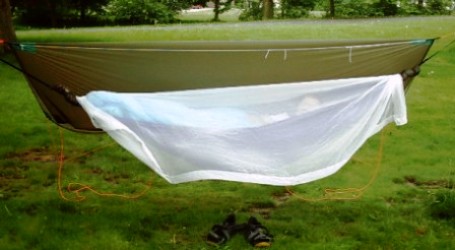
- Clark Jungle Hammocks. Clarks have zippers on both sides of the bugnet so you can roll it all the way to the top and secure it. It's not totally removable, so you'll still have to carry the weight when it's not needed in the winter, but you can get stuff from outside or increase ventilation as desired.
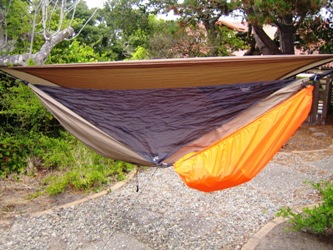
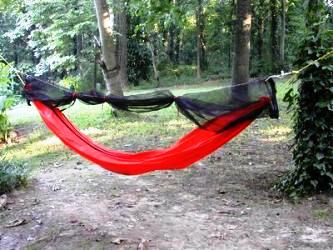
- Homemade Fixed Bugnets. Just like any other piece of gear, there are many options for a homemade fixed bugnet. One example is Risk's Quarterweight hammock, in which one side of the bugnet is sewn to the hammock's long side and secured to the hammock at each end. To deploy, just climb in and flop it over. Risk's first version had quarters sewn into the "floppy edge" to hold the net down, but his second version has pockets to put gear that he's already carrying...saves weight and is more convenient, too.

Risk's Flop-Over Bugnet
Originally on Risk's Quarterweight Hammock Page
![]() |
|
The orange piece is the Pack Cover / Gear Hammock |
Originally in Yahoo Hammockcamping Photos |
| Removable Bugnets. |
- Speer Hammocks. Ed Speer's hammocks have a strip of velcro down each long side of the hammock, and the bugnet has the matching velcro down its long side. There's a mitten clip on the ends of the bugnet that attaches to a small ring on the hammock support webbing. When you clip the bugnet on, tension pulls it tight so the hammock doesn't need an actual ridgeline. This system allows the occupant to enter on either side, and you can reach gear outside the hammock, or even cook from the hammock (with the stove safely on the ground, obviously), simply by opening a section of the velcro. To remove the bugnet, just undo the velcro and unclip the mitten hooks.
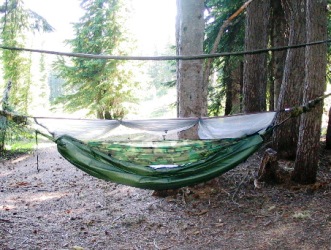
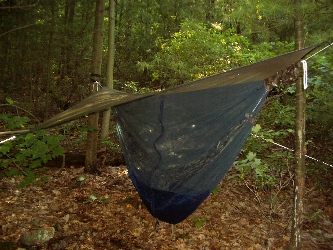
- Homemade Versions. There are lots of way to make removable bugnets. One easy way is just like the Speer version but without the velcro. Mirage made a bugnet that lays over a ridgeline, and has a shockcord running around the bottom perimeter to snug the net to the hammock.

Mirage's Bugnet with Shockcord
Photo from Mirage's Page
Mirage's Bugnet Stowed
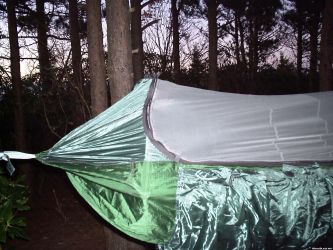
Photo from Mirage's PageVick's bugnet is like Mirage's...a shockcord on each end keeps it pulled tight, and velcro seals the ends. The white part is elastic casing with shockcord inside to snug the bugnet against the bottom of the hammock. He also put grosgrain stake loops so he can use it on the ground. This bugnet weighs 9 oz.

Vick's Bugnet
Photo by Vick
Stake Loops on Vick's Bugnet
Photo by Vick

Youngblood's Bugnet Stowed
Photo by Youngblood
| Bugnet Tubes. |
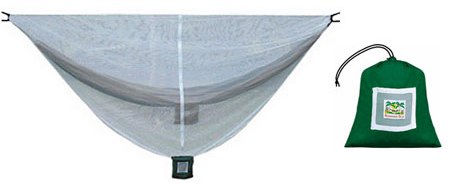
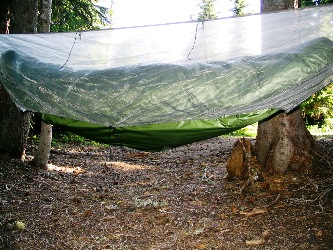
- Hammock Bliss Mosquito Net Cocoon. Hammock Bliss makes one and two person hammocks, and Mosquito Net Cocoon surrounds the entire hammock like a tube. You enter through the zipper in the side. This model is 100" long and weighs 11 oz. Kinda heavy, but it's a great idea. You could use lighter no-see-um to save weight, like Patti's bugnet below.

Hammock Bliss Mosquito Net Cocoon
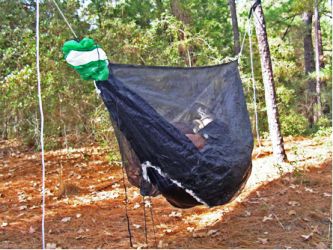
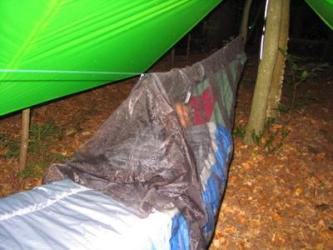
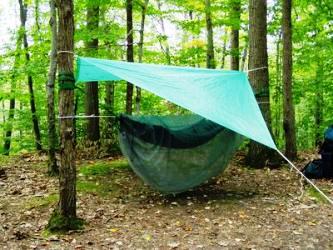
Photo from Campmor.com - Homemade Tubes. Hammock tubes are just what they sound like...a tube that slips over the hammock. It can be a cylinder cinched up at one end with a drawstring, or you can taper the ends, which saves weight, but adds complexity. My Hammock Sock has one tapered end and one large open end...I slide the open end over me and cinch up the drawstring. Patti's bugnet (below) is tapered at both ends, and she put a zipper in for side entry. Hers also has a silnylon bottom that she sometimes stores gear in, and it weighs only 5.8 oz.
![]() |
![]() |
Jonas4321's Bugnet Tube |
Patti's 5.8 oz Bugnet Tube with Silnylon Bottom |
Hammock Engineer's Bug Bivy Mk II (124" long, 12.4 oz, #5 zipper for durability) |
|
| Other Options. |
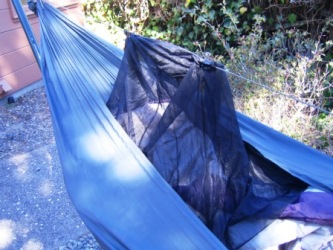
- I made a Jardine-style headnet to wear while hiking, and I can put it across the ridgeline to keep bugs off my face. I have to keep my body under the quilt and make sure my head stays under the net, but it's lightweight and multi-purpose.
Homemade Headnet on My Hammock
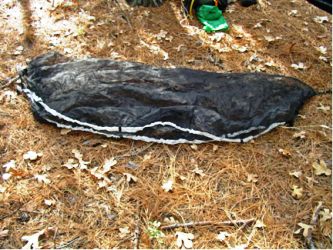
- DebW's Bug Bivy

DebW's Bug Bivy
Photo by DebW
| Chemical Treatments. |
- Permethrin. Soak your hammock in Permethrin and let it dry before the trip. Bugs will die when they land on it before they have time to bite through the fabric, and they'll often avoid the area altogether. Permethrin is dangerous in liquid form, but is pretty harmless once it has dried on the fabric. One treatment should last a season. Ed Speer often uses this method.
| Site Selection. |
Just like staying warm and dry, site selection is one of the most important factors in staying away from bugs.